Ming Xian Ridge is a famous tourist attraction in Hubei, offering cultural heritage. Ticket: ¥100. Rating: 4.6/5.
Ming Xian Ridge
Ming Xian Ridge is a famous tourist attraction in Hubei, offering cultural heritage. Ticket: ¥10…
🥇 5A Level ⭐ 4.6 🗺️ Hubei 🏙️ Jingmen 🏛️ Cultural
Spot Facts
| Level | 5A |
|---|---|
| Rating | 4.6 |
| Foreign name | The Xianling Tomb of the Ming Dynasty |
Practical Info
| Ticket | 100元 |
|---|---|
| Opening hours | 08:00-18:00 |
Ming Xianling Mausoleum Guide
Real coordinates · smooth curved routeMing Xianling Mausoleum — a UNESCO World Heritage Site (inscribed in 2000 as part of the Imperial Tombs of the Ming and Qing Dynasties) and a national 5A scenic area — stands on Songlin (Chunde) Hill northeast of Zhongxiang, Jingmen, Hubei. It is the joint tomb the Jiajing Emperor built for his father, Prince Xingxian Zhu Youyuan, posthumously honored as Emperor Xian, and his mother, Empress Dowager Zhangsheng. Facing south against the hill, the complex runs about 1.6 kilometers north to south. Its twin mound cities joined by a terrace are unique among Ming imperial tombs, and the Outer and Inner Ming Ponds, the nine-bend Imperial River, the five stone bridges, and the dragon-shaped spirit road all bear the site's distinctive design. Allow about two hours to walk the full site.
⏳ Loading map…
-
Outer Ming PondStart · Sight
-
Nine-Bend Imperial River & Five Bridgesabout 710 m (straight line) from the previous stop · SightWaimingtang lies at the southernmost end of the tomb area, converted from a natural pond and connected to the Mochou Lake water system; it is the starting point of the feng shui layout of "mountains on three sides, water on one." Heading north along the spirit way, the Nine-Bend Imperial River winds like a water dragon, with five stone bridges spanning it side by side; the finely carved bridge railings make this the most photogenic waterscape in the tomb area. Why this route: Waimingtang gathers qi and the imperial river resembles a dragon—the opening already reveals the distinctive feng shui craftsmanship of Xianling: the mingtang "stops at water" to gather spiritual energy, while the Nine-Bend Imperial River and the dragon-shaped spirit way echo the "two dragons playing with a pearl," the key to understanding an imperial tomb.
-
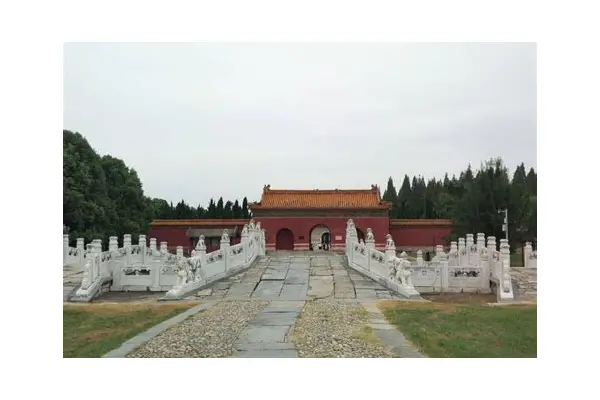
Red Gates (New & Old)about 750 m (straight line) from the previous stop · EntranceCrossing the bridge brings you to the Red Gate. The Old Red Gate, built in the 4th year of Jiajing (1525), sits on the central axis as the second gateway; the New Red Gate, built in the 18th year of Jiajing (1539), stands off-axis at the southern end like the tail of the spirit way's roaming dragon. Both gates have red walls, yellow tiles, and three arched openings—one central, one offset—a rare "double gateway" layout from the tomb's expansion into an imperial mausoleum. Why this route: The old and new Red Gates, one central and one offset, witness the expansion from Prince Xingxian's tomb to an imperial mausoleum—the most direct footnote to Xianling's transformation "from prince to emperor."
-
Spirit Road (Stone Statues)about 470 m (straight line) from the previous stop · SightLeaving the Red Gate, you enter the spirit way. About 1,300 meters long, it has a bluestone "dragon spine" down the center and pebble "dragon scales" on both sides, winding like a roaming dragon—the only fully preserved dragon-scale spirit way among Ming imperial tombs. Stone statues stand in pairs along the path: lions, xiezhi, camels, elephants, qilin, and standing horses—six auspicious beasts in sequence—majestic all the way to the Lingxing Gate. Why this route: With dragon-scale paving and rows of auspicious beasts, the spirit way is Xianling's most spectacular ceremonial avenue and the most imperial, most photogenic walkway in the tomb complex.
-
Inner Ming Pondabout 150 m (straight line) from the previous stop · Sight
-
Ling'en Gate Ruinsabout 10 m (straight line) from the previous stop · EntranceAt the northern end of the spirit way, past the Lingxing Gate, is Neimingtang, a round pond anciently called "mingtang water," meant to gather qi and protect the tomb. North of the pond are the ruins of the Ling'en Gate, originally three bays wide with a glazed screen wall and cloud-dragon ramp in front; inside are the ruins of the Ling'en Hall, originally five bays wide and four deep, the main hall for spring and autumn sacrifices. Both structures were destroyed in the wars of the late Ming; only platforms and column bases remain. Why this route: Neimingtang's "mingtang water" together with the Ling'en Gate and Hall ruins forms the sacrificial core: one pond and two hall foundations encapsulate the ritual system and grandeur of Ming imperial sacrifices.
-
Ling'en Hall Ruinsabout 10 m (straight line) from the previous stop · SightHeading north along the central axis, pass the Inner Red Gate, the Two-Column Gate, and the Five Stone Offerings, then climb the Ming Tower. A double-eaved hip-and-gable pavilion, it houses the stele "Tomb of Emperor Gongruixian," with twin dragons carved on top and characters over a foot tall—direct physical evidence of Emperor Jiajing posthumously honoring his father as emperor. From the tower, the twin treasure cities and spirit way unfold below—the best viewpoint of the entire route. Why this route: The Ming Tower stele, with the title "Emperor Gongruixian," captures the aftermath of the Great Rites Controversy; from the top, the twin treasure cities and the spirit way's axis are all in view—a double climax of sight and history.
-
Ming Towerabout 770 m (straight line) from the previous stop · Sight
-
Yaotai Terraceabout 760 m (straight line) from the previous stop · Sight
-
Twin Mound Citiesabout 100 m (straight line) from the previous stop · SightNorth of the Ming Tower is Yaotai, a stone-paved passage connecting the front and rear treasure cities. The front treasure city was built by adding earth to Prince Xingxian's tomb mound in the 15th year of Zhengde (1520); the rear was added in the 18th year of Jiajing (1539) when Empress Zhangsheng was buried with him. Joined by Yaotai, the two form the "one tomb, two mounds" unique to Ming imperial tombs. Return by the same path or the west walkway. Why this route: Yaotai and the twin treasure cities are the soul of Xianling: "one tomb, two mounds" is unique among Ming imperial tombs—father and son in one tomb, from prince to emperor—fully displaying Emperor Jiajing's extraordinary filial piety and the final outcome of the Great Rites Controversy.
Photos